Beyond Linear Limits

As markets shift, some principles only become more relevant with time.
Reflecting on what we learned in the online brokerage world, it’s clear that linear thinking isn’t just outdated—it’s restrictive. In today’s mortgage landscape, exponential thinking in Go-to-Market (GTM) is a necessity. We’re not talking about simply tuning sales tactics or boosting acquisition. This is about creating an interconnected, end-to-end system that aligns every point of the customer journey.
Back in 2022, online brokerages surged on the back of pandemic-driven adoption and digital acceleration. This growth was exponential. Each new user wasn’t just another account but a force multiplier, sparking a compounding effect. Our GTM strategy had to adapt—quickly—to handle scalable, dynamic growth. Now, as we face the “great mortgage renewal,” those dynamics echo, even if the growth here is cyclical, not exponential. It’s a different rhythm but requires the same disciplined, scalable approach.
Unlike brokerage, where growth compounded with each new user, the mortgage renewal market follows a cyclical, wave-like pattern. According to recent RBC Capital Markets data, 60% of Canadian residential mortgages are set for renewal between 2024 and 2028, with intense peaks in 2025 and 2026. This pattern isn’t purely exponential or linear; it’s cyclical with non-linear peaks driven by the fixed terms of mortgage contracts.
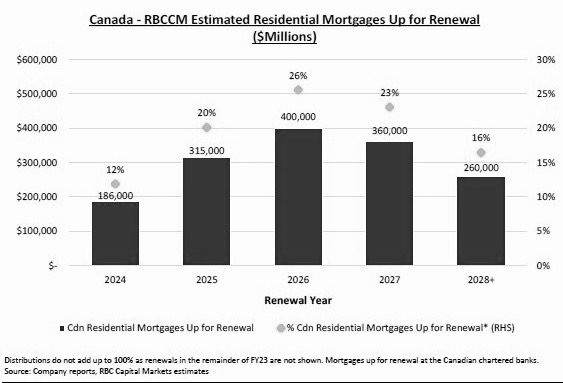
↑ Percentage of Canadian Mortgages Up for Renewal (2024–2028)
This renewal wave isn’t a steady incline. Roughly 45% of Canadian mortgages are set to renew over the next two years alone. This isn’t linear growth; it’s a wave that demands a different approach—one that anticipates high-volume periods and scales accordingly. A cyclical, burst-style growth requires a GTM strategy that’s both adaptable and built for speed.
Applying Exponential Thinking to this Market
While this isn’t exponential growth in the strict mathematical sense, exponential thinking is exactly what’s needed to handle the surges in demand shown in the graph. Here’s how we’re turning these insights into a resilient GTM strategy for mortgage renewals:
1. Scalable, Responsive Infrastructure
Meeting renewal demand means building infrastructure that can absorb these cyclical, non-linear peaks without compromising service. In brokerage, scaling platforms to handle compounding growth ensured consistency for both new and returning clients. Now, the mortgage market demands a similar approach: : digital tools, AI-driven insights, and customer portals that support high volumes and deliver personalized experience. With exponential thinking, renewals aren’t treated as isolated events. Instead, we design for waves of users, building infrastructure that adapts to cyclical demand.
2. Dynamic Retention and Acquisition Loops
In 2022, we relied on network effects to reduce acquisition costs and improve retention in brokerage. In mortgages, retention and acquisition now go hand-in-hand, especially as we create a digital ecosystem that keeps clients connected across renewal cycles. Exponential thinking in a cyclical market means reaching customers early, guiding them through choices, and fostering ongoing engagement. Each renewal becomes part of a long-term client relationship that compounds in value over time, even as renewal volumes peak and dip according to their cycle.
3. Speed and Agility for Cyclical Demand
In GTM, speed is non-negotiable—especially in a cyclical market. Rapid product rollouts and agile updates are critical when demand spikes. The mortgage market demands solutions that adapt in real time to shifting rates and renewal waves. Linear GTM approaches might treat each renewal as a one-off event; exponential thinking reframes each interaction as an opportunity to deepen trust and loyalty, particularly during high-volume years. This strategy builds agility directly into our GTM approach, aligning real-time insights with targeted offers.
As I noted back in 2022, linear thinking might work in predictable environments, but it’s insufficient for today's markets with demand surges. The great mortgage renewal is a transformational moment—a chance to meet Canadians’ needs in ways that scale beyond one-time solutions. By applying exponential thinking, we’re not just processing renewals; we’re building a resilient model that grows with the market and anticipates cyclical peaks.
The mortgage industry, like brokerage, is constantly shaped by external forces and evolving expectations. To succeed, our GTM strategy must be built on systems, relationships, and approaches that scale and multiply in value—even in a market driven by cycles and bursts.
None of this works without unified leadership from the top. When there is engagement at leadership in GTM, the entire organization feels it. GTM stops being a siloed effort—it becomes a seamless system where every part of the customer journey aligns under a unified vision. Every department, from marketing to product to customer success, understands its role in delivering a consistent, connected experience.
Seeing the Bigger Picture
When the GTM system is fully aligned, every step forward compounds. Growth in a cyclical market isn’t just managed; it’s optimized. Because in the end, true compounding isn’t only about numbers—it’s about building something that scales and sustains itself, delivering lasting value in every wave and cycle.
GTM transformation is a long game, and it starts by breaking away from linear thinking. Shared KPIs unify the executive team, aligning every function around one purpose. This shifts from isolated silos and finger-pointing to a unified push to strengthen the entire GTM engine. These aren’t just metrics—they’re the glue that shifts us from isolated silos to a cohesive, powerful GTM engine. It’s what makes the system scalable and resilient, as critical as data or infrastructure.
In our non-linear world, linear thinking won’t cut it. We need strategies that compound value across every cycle, not just isolated wins. When GTM is fully aligned, every step forward builds momentum. Growth in this market isn’t just managed; it’s amplified. Because ultimately, true compounding isn’t about numbers—it’s about creating something that scales and endures, delivering real, lasting value through each wave.