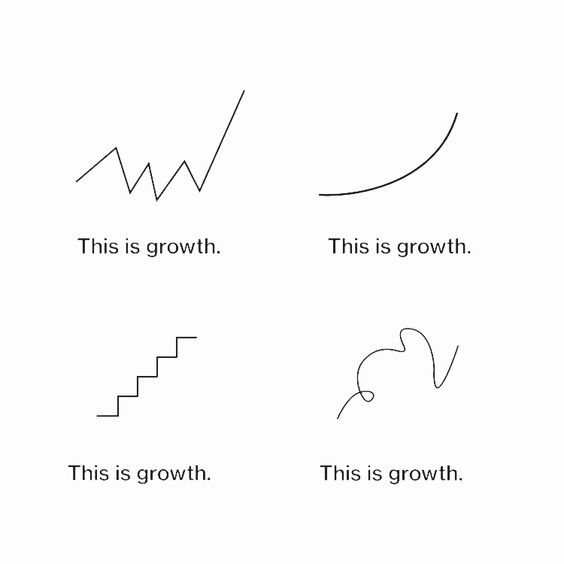
You're Guessing

Without Understanding Mathematical Growth Models, You’re Guessing
They’re the backbone of any effective growth marketing strategy. If you don’t grasp them, your marketing is based on guesses, not data.
Think About It:
- Are you strategically planning your growth phases or just hoping for the best?
- Do you know exactly when to accelerate or hold steady?
- Can you forecast when your growth will hit a ceiling?
Your marketing needs precision, not guesswork. A fundamental understanding of the math behind growth is necessary to transform your approach.
For example, if you assume steady customer acquisition, your growth marketing strategies will be built for manageable scaling and resource allocation. This is vastly different from exponential growth, which is built for rapid expansion.
The Best Example -> Where Digital Was vs. Today
Once upon a time, digital banking was offering online account access. It was a linear growth model—slow and steady. A decade ago, there was a focus on transitioning customers from physical branches to online platforms, ensuring that each step was manageable and controlled.
Today, the story is different. Banking is digital banking. It is about seamless integrations, AI-driven insights, and instant customer support.
Then:
- Limited Services: Basic online account management and transactions.
- Gradual Adoption: Customers slowly shifted from in-person to digital interactions.
- Predictable Growth: Incremental increases in online users with steady infrastructure upgrades.
Today:
- Seamless Integrations: Digital banking now offers a full suite of services, including AI-driven financial advice, instant customer support, and integrated investment platforms.
- Explosive Adoption: Fintech partnerships and innovative features drive exponential user growth.
- Dynamic Scaling: Advanced analytics and automation allow banks to scale rapidly, responding to real-time customer needs and market trends.
This shift to exponential growth models has transformed the landscape, enabling banks to scale rapidly and meet evolving customer expectations. FIs that fail to recognize and adapt to this shift find themselves stuck using outdated tactics like getting a freebie, which no longer resonate in a world where customers demand instant, integrated, and intelligent solutions.
These old-school methods not only fall flat but also squander valuable resources that could be better invested in strategies aligned with exponential growth. Without the right growth model, your marketing efforts lack direction and scalability, making it impossible to keep up with the rapid advancements and heightened expectations in the digital banking landscape.
Building the Right Strategy with Mathematical Precision
To avoid building your growth marketing strategies on shaky ground, it's imperative to anchor them in robust mathematical growth models. Understanding whether your growth trajectory is linear, exponential, or follows another pattern allows you to tailor your marketing tactics to fit the phase you’re in. For instance, during a phase of exponential growth, leveraging data-driven insights and automation can amplify your reach and efficiency, ensuring that your marketing scales alongside your customer base. Conversely, a linear growth model would benefit more from steady, consistent marketing efforts that reinforce brand loyalty and incremental customer acquisition. By aligning your strategies with the appropriate growth model, you ensure that every marketing dollar is spent effectively, driving sustainable and scalable growth. Embrace the math, and watch your marketing strategies transform from blind guesses to calculated engines of success.
And what's the cost if you don't?
Here’s what you risk:
- Ineffective Resource Allocation: Without precise models, investments in marketing, technology, and customer service become guesswork, leading to wasted resources.
- Unpredictable Growth: Relying on intuition makes it impossible to forecast growth accurately, increasing the risk of overextension or stagnation.
- Competitive Disadvantage: Banks leveraging mathematical models outpace competitors by making smarter, faster decisions based on solid data.