A non-linear world

Linear thinking isn’t wrong; it’s just out of sync with a world that rarely moves in straight lines.
When we try to manage change with linear tools, we end up patching over inefficiencies rather than building systems ready to flex, scale, and thrive under pressure. Linear thinking feels intuitive because it’s comfortable and predictable, but in today’s fast-moving world, it often leaves us chasing rather than leading.
To understand the difference, imagine starting with a single penny. With a linear approach, you add one penny every day. After 30 days, you’d have 31 pennies, or just $0.31. Now imagine doubling your pennies every day instead. After 30 days, this exponential growth would leave you with over 536 million pennies, around $5.37 million. While linear growth adds a little each day, exponential growth multiplies, creating outcomes that are almost unimaginable by day 30.
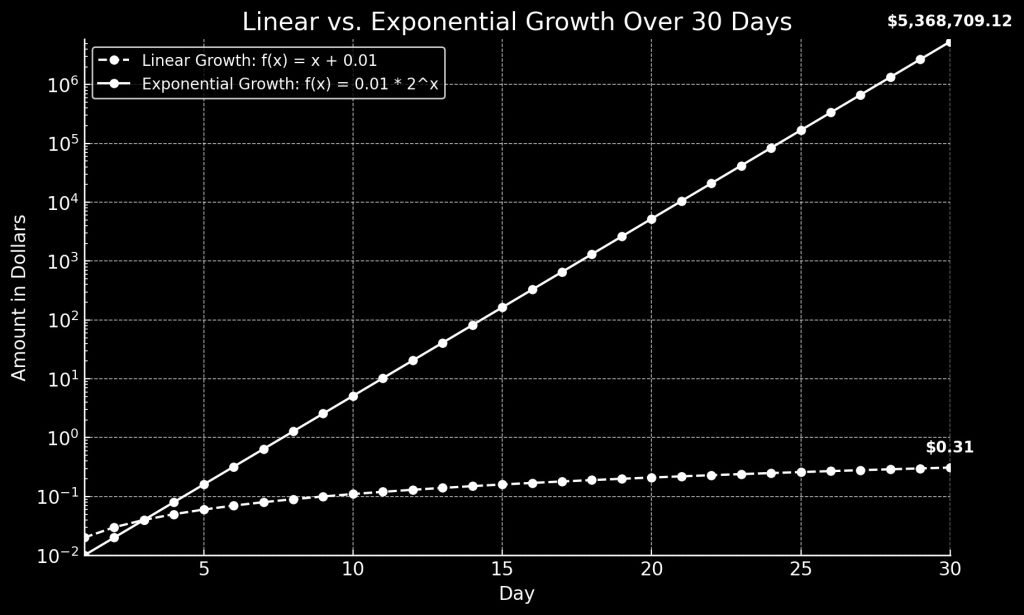
↑ Here’s the graph showing linear versus exponential growth over 30 days. The linear growth line follows the function f(x)=x+0.01f(x)=x+0.01, adding a fixed amount each day, while the exponential growth line follows f(x)=0.01×2xf(x)=0.01×2x, doubling each day. The logarithmic scale on the y-axis highlights the vast difference in outcomes by the end of the month.
In markets shaped by sudden shifts and cycles, like finance and the economy, linear thinking often falls short. Take online brokerages during the pandemic: a massive surge of new, younger investors led to exponential growth. These platforms couldn’t rely on simple, linear growth models to keep up; they had to scale quickly to handle millions of new accounts and huge trading volumes in a matter of weeks. Or consider today’s mortgage market, where rising interest rates are creating spikes in demand for refinancing and renewals. Borrowing habits don’t change slowly and predictably. When rates shift, they drive sudden demand for mortgage adjustments as homeowners rush to adapt.
Exponential thinking in these scenarios isn’t about trying to predict every twist and turn; it’s about building systems that are flexible and resilient, ready to handle sudden pressure. Instead of viewing growth as a steady, controlled path, we see it as a series of waves and cycles that require systems designed to expand when demand surges and recalibrate when it slows. This way, we don’t just react to shifts, we’re ready for them, with structures that allow us to not only manage the surge but turn it into a strategic advantage.
Linear thinking leaves us vulnerable to the reality of exponential change.
Companies that stick to linear approaches risk being overtaken, policymakers struggle to keep pace, and an accelerating future feels harder to control. By shifting to exponential thinking, we’re better equipped to spot opportunities and adapt to the unexpected. When our strategies match the speed and complexity of real growth, we’re no longer just managing the future, we’re leading it.